What Is a Good Utilization Rate on Turo? Data From 867 Cars
How many days Turo cars are really booked, from 867 cars in Atlanta and Houston: the typical range, what counts as good, why 20 days a month is rare, and what goes with more bookings and more revenue.
Ask what utilization a Turo car should get and you’ll hear 80% from coaches, “at least 15 days” from hosts, and 21 days from Turo’s own Carculator, where the slider starts. Nobody shows what real cars do. So we measured it.
In October 2026, Raptor Explorer read the booking calendars of 867 cars: 667 in metro Atlanta and 200 in Houston. For most of this post we use the 779 that had been listed for at least three months, because a car’s first weeks say little about the rest of its year. Every number below comes from those tables unless a source is linked.
The short answer
- The typical car is booked about 47% of days, or 14 a month, in both Atlanta and Houston. The middle half: 36% to about 60%, or 11 to 18 days.
- Good is the top quarter for your kind of car: about 58% to 61% of days or more, or 18 days.
- 20 days a month is rare. 11% of established Atlanta cars and 18% in Houston got there. 80% almost never happens.
- The busiest cars are not the best earners. Only a third of Atlanta’s top-earning cars were among its busiest. Price matters as much as booked days.
What utilization means
Utilization = days booked ÷ days the car could have been booked. Multiply by 30.4 for booked days a month:
| Utilization | Booked days a month |
|---|---|
| 30% | 9 |
| 40% | 12 |
| 47% | 14 |
| 50% | 15 |
| 60% | 18 |
| 66% | 20 |
| 75% | 23 |
| 80% | 24 |
The idea is the same everywhere, but who counts what differs:
- Rental companies. Hertz divides rented days by its available car days and reported 81% for 2025 (Hertz 10-K). Avis reported 70.1% (Avis). They run professional fleets at airports, with staff to turn cars around.
- Airbnb analytics. AirDNA counts booked nights against nights that were open to book, and works to leave out nights the host blocked (AirDNA). US short-term rentals averaged 54.3% (AirDNA).
- Turo. Turo publishes no utilization rate. Its 2025 US average was 15 booked days a month (Turo), and its host updates call a car booked 17 days a month “higher-utilization” and one booked 11 days “lower” (Turo).
- Raptor Explorer. Days the car was unavailable all day, divided by the days with calendar data (formulas). Turo hides a car from search both for booked dates and for dates the host blocked (Turo help), so from outside the two look alike. Treat any calendar-based utilization, ours included, as an upper bound.
What real cars get
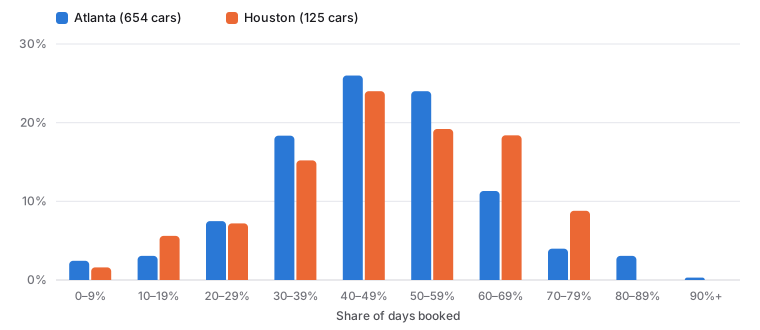
| Cars listed 3+ months | Atlanta (654) | Houston (125) |
|---|---|---|
| 10th percentile | 27% (8 days) | 24% (7 days) |
| 25th percentile | 36% (11 days) | 36% (11 days) |
| Median | 47% (14 days) | 48% (15 days) |
| 75th percentile | 58% (18 days) | 61% (19 days) |
| 90th percentile | 67% (20 days) | 70% (21 days) |
| Booked 66% or more (20+ days) | 11% of cars | 18% of cars |
| Booked 80% or more | 22 cars | none |
Two different cities, almost the same middle. Most cars sit between 30% and 60%. Compare that with what you’ll hear:
- “80%, or 24 days a month,” is the target coaches quote (CarShare Academy, Car Rental Coach). It is a rental company’s number. On Turo, 22 of 654 established Atlanta cars reached it, and none in Houston.
- “At least 15 days, aim for 20,” is the common view on r/turo. 15 days is about the median here, and 20 is the top 10% to 20%.
- “21 days” is where Turo’s Carculator slider starts for every car. That’s the top 10% in both cities.
Plan with the median for cars like yours. Make sure the car covers its costs at the 25th percentile, and treat anything above the 75th as upside. The Turo ROI calculator shows what each figure does to profit.
What good means for your car
Compare a car with cars like it. In both cities, SUVs were booked more than sedans:
| Median share of days booked | Atlanta | Houston |
|---|---|---|
| SUVs | 50% (327 cars) | 52% (135 cars) |
| Cars, mostly sedans | 43% (286 cars) | 41% (48 cars) |
| Minivans | 45% (34 cars) | 43% (12 cars) |
All analyzed cars. A sedan booked 50% of days is doing well, and an SUV at 50% is average. For individual models, see Best Cars for Turo in Atlanta.
New listings fool the sort
Sort any table by utilization and the top is crowded with cars that were just listed. A car listed 40 days ago that took two long trips shows 80% or 100%:
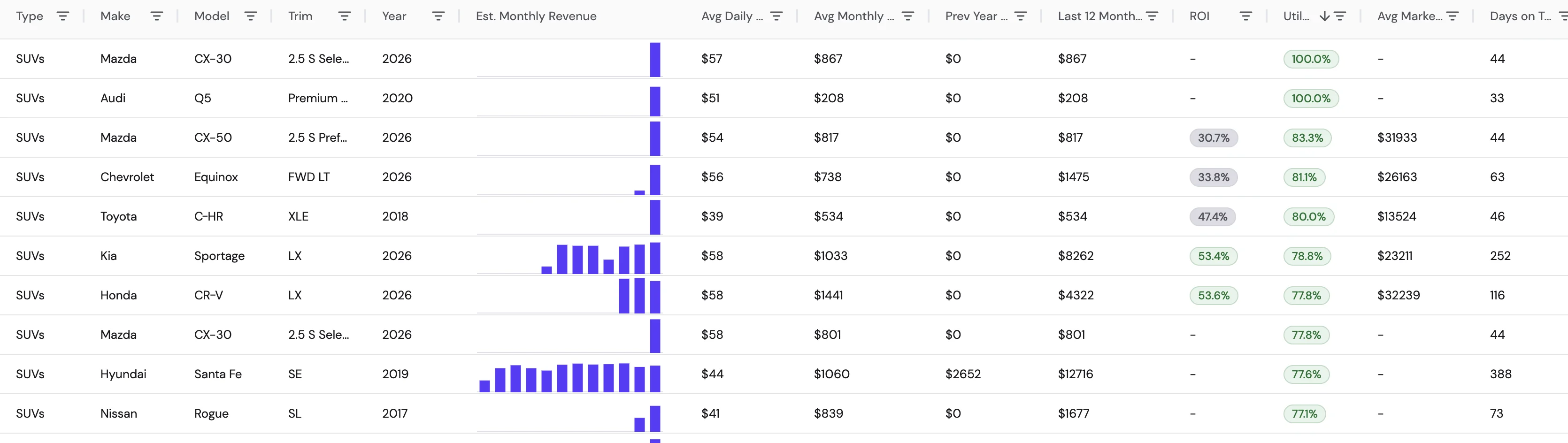
New listings fool the bottom of the sort too. In Houston, 26 of the 28 cars booked under 10% of days had been listed for less than three months. In Atlanta, the 13 cars listed less than three months were booked 40% of days. After that, age made almost no difference: 47% at 3 to 6 months, 47% at 6 to 12, 48% at 1 to 2 years and 47% after 2 years.
So judge a car on at least three months of data, ideally a full year. A summer listing hasn’t seen January yet.
Utilization isn’t the goal
Revenue is booked days times price. Hotels track the two together as revenue per available room (CoStar). The Turo version is revenue per day listed: utilization × daily price. It was $28 for the median car in Atlanta and $24.50 in Houston.
The busiest cars weren’t the best earners:
- In Atlanta, the busiest quarter (58% of days or more) charged a median $54 a day and brought in $1,036 a month.
- The top-earning quarter ($1,146 a month or more) was booked 52% of days at $74 a day.
- Only a third of the top earners were also among the busiest cars. In Houston, 42% were.
And cutting price didn’t buy bookings. We compared each car’s daily price with the median price for its model, in the 30 Atlanta models with at least 6 cars:
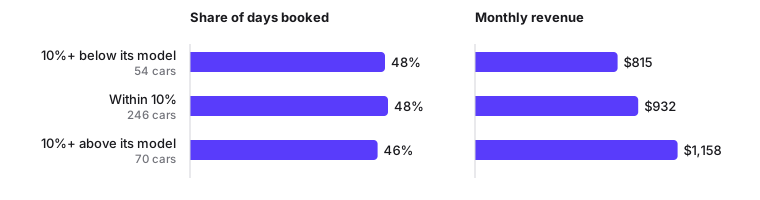
Cars priced at least 10% below their model were booked no more often than cars priced near it, and earned less. Cars priced at least 10% above were booked about 2 points less and earned 24% more a month.
This is not proof that raising your price works. The cars priced above their model were a year newer on average, more often run by All-Star hosts (83% against 67%) and more often delivered to the airport (60% against 27%). What the data does show is that the busy cars were not the cheap ones. Hotels found the same pattern: hotels priced below their competitors filled more rooms but did not earn more per room, and hotels priced above them earned more (Cornell). Hertz lived it in 2025: its daily price fell 4%, utilization rose 2 points, and revenue per car fell 2% (Hertz).
One limit on the other side: Turo flags days priced 20% or more above its recommended price and warns they may rank lower in search (Turo help).
What goes with more booked days
| Median share of days booked | Atlanta | Houston |
|---|---|---|
| Fewer than 10 reviews | 27% (39 cars) | 35% (73 cars) |
| 10 to 49 reviews | 47% (359 cars) | 52% (91 cars) |
| 50 or more reviews | 48% (269 cars) | 46% (36 cars) |
| All-Star host | 48% (441 cars) | 51% (115 cars) |
| Not All-Star | 45% (226 cars) | 41% (85 cars) |
| Airport delivery offered | 45% at $69 a day | 46% at $57 a day |
| No airport delivery | 48% at $56 a day | 47% at $48 a day |
All analyzed cars. These go together; they don’t prove cause. A car with more trips also collects more reviews.
- Reviews are the clearest line. Cars with fewer than 10 reviews were booked far less in both cities. After about 10, more reviews made little difference.
- All-Star hosts’ cars were booked more, by 3 points in Atlanta and 10 in Houston. All-Star status takes 20 or more trips in a year, at least 85% five-star ratings and no more than 3% cancellations (Turo help).
- Airport delivery traded days for price. Cars offering it were booked slightly less but charged more, and earned more per month in both cities.
- Mileage limits made no consistent difference. Most cars allowed 200 miles a day.
Turo’s own guidance on getting more bookings (Turo help):
- At least 10 good photos.
- Low-cost airport delivery.
- A price near its recommendation.
- Good ratings.
- A calendar kept current.
- Quick answers to change requests.
- Trip length. Turo says trips of three days or more lead to higher utilization (Turo help).
- Instant booking is no longer something to switch on. Every booking has been instant since 2024 (Turo help).
How to check a car before you buy one
- Find its comparables. The same model, a couple of model years either side, in your area. The market analysis guide shows how to collect them.
- Drop listings under three months old. Use the rest for the median and the 25th percentile.
- Look at a full year. Monthly revenue shows the slow months that a single booked-days figure hides.
- Check revenue per day listed, not just utilization. A car booked 45% of days at $70 out-earns one booked 55% at $50.
- Run the costs at the 25th percentile in the ROI calculator. If the car only works at the top of the range, it’s the wrong car or the wrong price.
What this data can’t tell you
- Booked or blocked. A day the host blocked looks like a booked day, so all of these figures are upper bounds.
- Two cities, one month. Atlanta and Houston in October 2026, from the cars Turo ranked highest in seven searches. Other cities, especially seasonal ones, will differ.
- Correlation, not cause. Cars with more reviews or All-Star hosts were booked more, but this doesn’t show that adding either would lift your car by the same amount.
Questions
What is a good utilization rate on Turo?
In our data from Atlanta and Houston, the typical car listed for at least three months was booked 47% to 48% of days, about 14 days a month. The top quarter of cars was booked 58% to 61% of days or more, about 18 days. So 55% to 60% is good, and anything above that is top-quarter territory. Compare against cars of the same type, because SUVs were booked more than sedans in both cities.
How many days a month does a Turo car get rented?
About 14 for the typical car in our sample of 779 established cars in Atlanta and Houston, with the middle half between 11 and about 18 days. Turo's own US average for 2025 was 15 booked days a month.
How do you calculate utilization on Turo?
Divide the days a car was booked by the days it could have been booked, then multiply by 30.4 to get booked days a month. From outside, a day the host blocked looks the same as a booked day, so calendar-based figures are an upper bound.
Does lowering my price get more bookings on Turo?
Not in our Atlanta data. Cars priced at least 10% below the median for their model were booked 48% of days, the same as cars priced near it, and earned less. Cars priced at least 10% above were booked 46% of days and earned 24% more a month, though they were also newer and more often run by All-Star hosts.
Is 80% utilization realistic on Turo?
Rarely. 22 of 654 established Atlanta cars and none of 125 in Houston were booked 80% of days or more. Rental companies with professional fleets get there: Hertz averaged 81% in 2025.