How to Do a Turo Market Analysis for Your City
A step-by-step Turo market analysis, worked through on 200 real Atlanta listings: what is listed, how often it is booked, what it earns, and whether the car you're eyeing would pay for itself.
Before you buy a car for Turo, you want to know three things about your market: what is already listed, what actually gets booked, and what it earns. Turo shows you one listing at a time, and a listing doesn’t show its past bookings. One host on r/turo put the problem plainly: you can’t see how many days a car actually rents each month.
This guide walks through a market analysis you can repeat for any city, worked through on a real one. On October 24, 2026, we searched Turo for Atlanta, for November 14 to 17. We recorded all 200 cars the search returned and analyzed 160 of them with Raptor Explorer, which reads each car’s booking calendar. Every number below comes from that table unless a source is linked. For the whole metro, broken down by model, budget and area, see Best Cars for Turo in Atlanta.
What 200 Atlanta listings showed
- The typical car was booked 13 days a month (44% of days). Only 4 of 160 reached 75%.
- The most listed model, the Toyota Corolla (12 listings), was booked less than the market: 38%.
- January earned 42% less than July for the same cars.
- Cars from 2014 to 2017 returned about twice the ROI of 2024 to 2026 cars, but Turo only accepts cars up to 12 years old.
1. Draw your market on the map
A Turo market is smaller than a city. Guests pick a car they can reach, or one that is delivered to them, so a car by the airport and a car across town compete for different trips. Decide the area you would really host in: where you live, how far you would deliver, and whether you will serve the airport.
The airport is worth deciding early. Nearly a third of Turo trips start and end at an airport, and Turo says those trips earned hosts 21% more each (Turo, November 2024 to November 2025). In our Atlanta search, 74 of the 200 cars offered delivery to ATL.
Then pick your search dates:
- At least three weeks out. Turo only shows cars that are available for the whole window, and a booked day and a day the host blocked both hide a car from search (Turo help). Search for tomorrow and the busiest cars disappear. Hosts give the same advice: cheap cars that rent constantly don’t show up in near-date searches.
- About three days long. Cars with a minimum trip length still appear, a tip from host Etienne Elsaesser.
- A quick demand check. Host Aubrey Janik compares how many cars are available in the next couple of days with how many are available months out. A big gap means cars are getting booked. It is a snapshot, not a measurement, but it takes a minute.
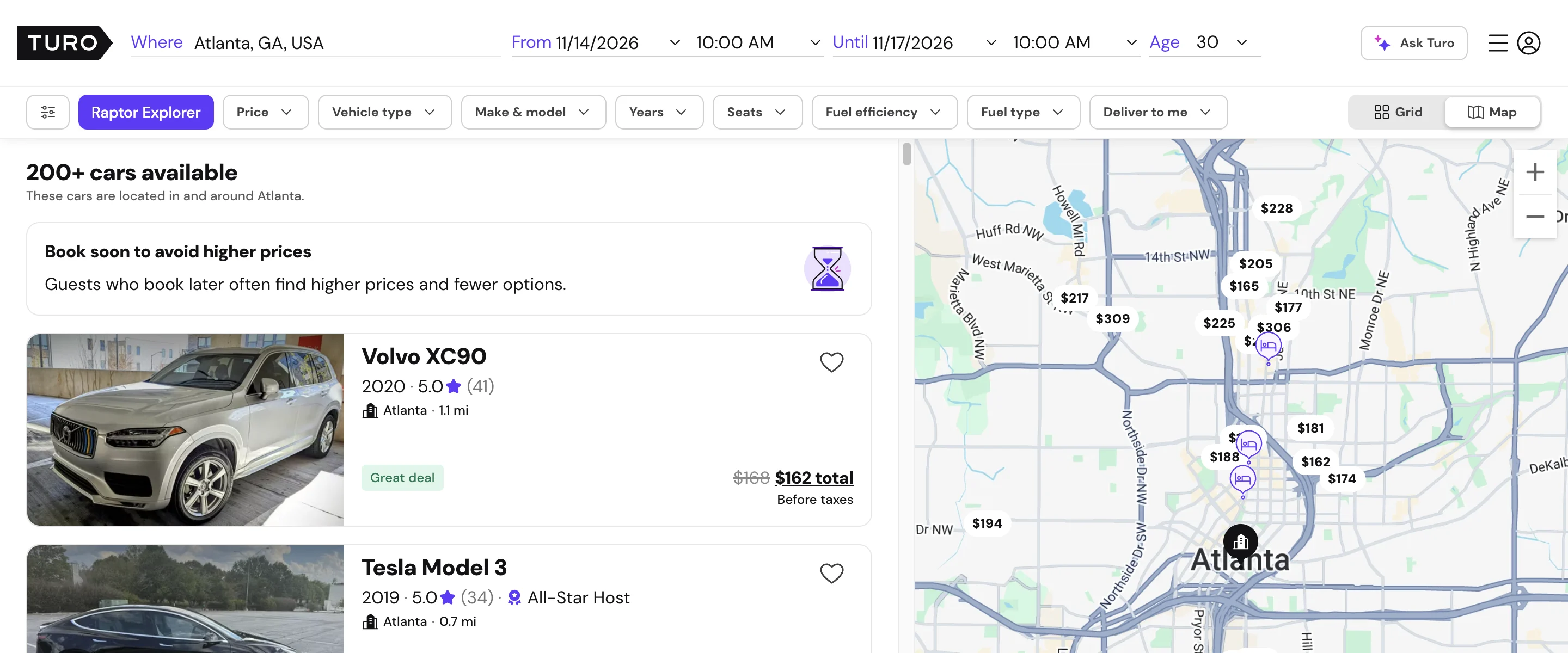
2. Collect every car, not the first page
One Turo search shows at most 200 vehicles, the ones Turo ranks highest (Turo help). Our Atlanta search hit that limit, so these 200 cars are central Atlanta, not the whole metro. To cover a larger area, move or zoom the map and search each part, and keep going until new searches stop adding cars you haven’t seen.
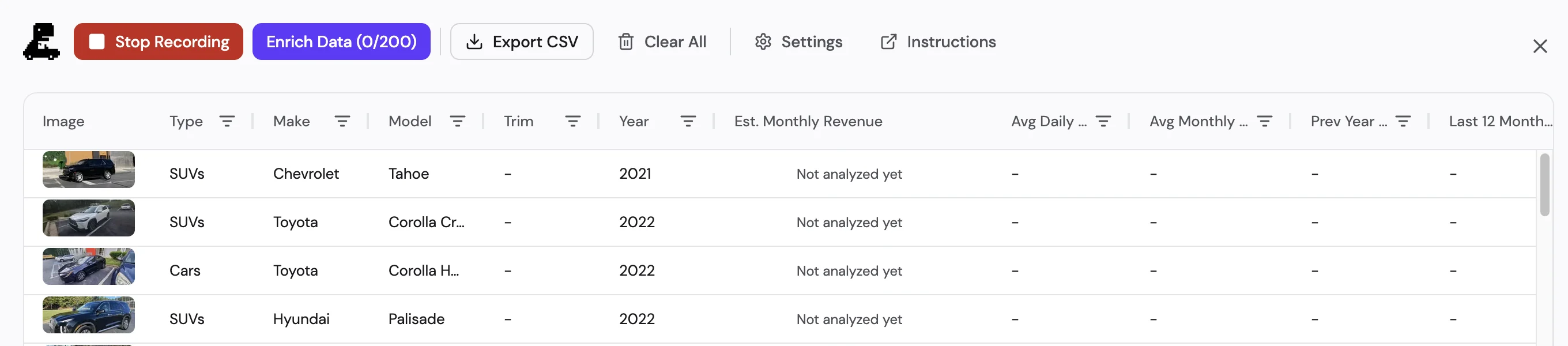
Doing this by hand means a spreadsheet and a lot of clicking. With Raptor Explorer, click Start Recording and every search adds its cars to one table (how it works). Then Enrich Data reads each car’s calendar and fills in its numbers.
3. Count what’s already there
Supply tells you what other hosts bought. Group the cars by type and model:
| In the Atlanta search | Count |
|---|---|
| SUVs | 104 |
| Cars | 89 |
| Vans, minivans and trucks | 7 |
| Most listed models | Toyota Corolla 12, Tesla Model 3 9, Tesla Model Y 9, Hyundai Elantra 8, Nissan Sentra 8 |
Hosts on r/turo use a few quick tests for a crowded market:
- Count your model. In one Dallas thread, a host asking about a Corolla was reminded that about 125 were already listed.
- Look at the price floor. Hundreds of cars under $40 a day is a sign the market has peaked.
- Count what is still available in a future week, by type. One host found 116 cars and 113 SUVs available in the first week of May, but only 11 minivans, 8 trucks and 8 vans. The scarce types were the gaps.
Also look at how long cars have been listed. In Atlanta, 47 of the 160 analyzed cars were listed less than six months ago, and about half less than a year ago. That is a lot of new hosts. The good sign: the new cars were getting booked, at 46% of days against 44% for the whole table.
4. Measure how often cars are booked
This is the number that decides whether a car pays for itself. Hosts call it utilization: booked days divided by the days the car was listed. Multiply by 30.4 for booked days a month.
Raptor works it out from each car’s calendar, counting a day as booked when Turo shows the car unavailable all day (formulas). From the outside, a day the host blocked looks exactly like a booked one, so treat every calendar-based figure, ours included, as an upper bound. Most guides on this topic don’t make that distinction.
In Atlanta, the median car was booked 44% of days, about 13 days a month. The middle half of cars sat between 34% and 55%, or 10 to 17 days. Only 4 of 160 reached 75%, and two of those had been listed for less than five months.
Compare that with what you will hear:
- Coaches quote 80%, or 22 to 25 days, as the target (Car Rental Coach, CarShare Academy). Those figures come from experienced hosts’ own fleets.
- Hosts on r/turo call 15 days a month the floor and 20 or more the goal (thread).
- Turo’s own 2025 average was 15 booked days a month (Turo). Its Carculator starts every car at 21.
So 20 or more days is top-performer territory, not a planning number. Plan with your market’s median for your kind of car. What is a good utilization rate on Turo? goes deeper, with Houston for comparison.
The model matters more than the type:
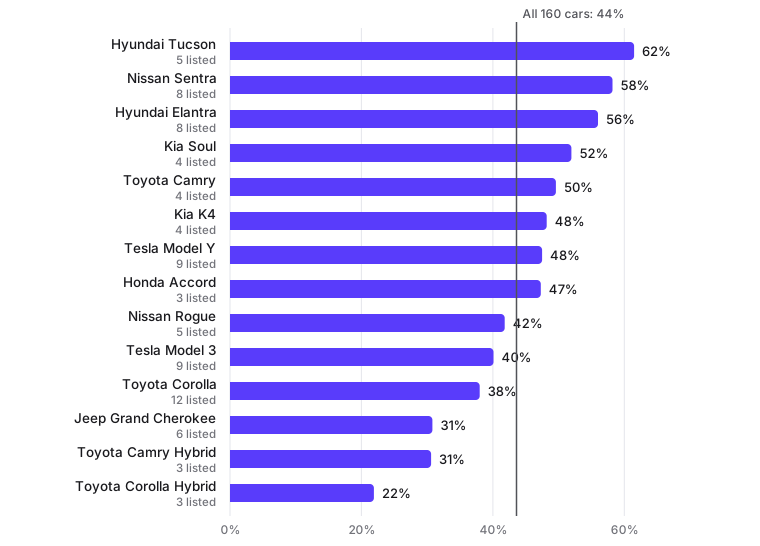
The Corolla, the most listed model in the search, was booked 38% of days. The Nissan Sentra and Hyundai Elantra, with 8 listings each, were booked 58% and 56%. Three or five cars is a small sample, so treat each bar as a lead to check, not a verdict.
One trap: sort by utilization and new listings rise to the top. Of the 20 busiest cars in Atlanta, 9 were listed less than six months ago. A car booked 80% in its first months hasn’t been through a slow season yet. Check Days on Turo before you trust a high number.
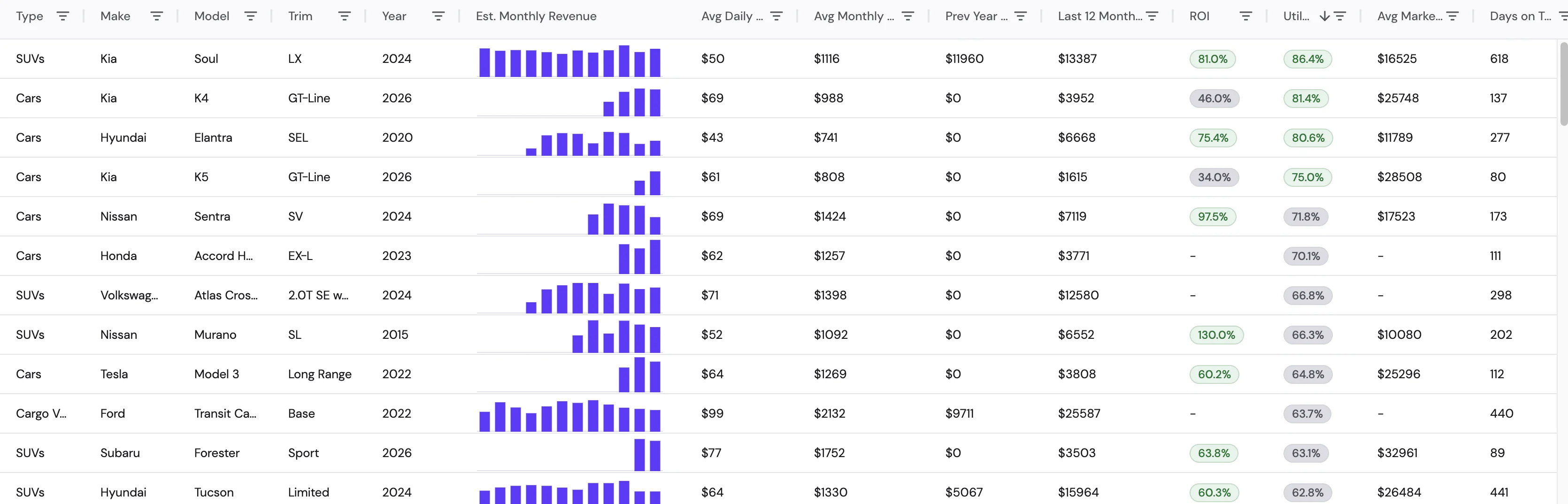
5. Look at prices, revenue and the slow months
Average daily price is what the booked days were priced at. Raptor reads the host’s daily prices from the calendar. That is not the price you see in search, which includes Turo’s fees (Turo help). In Atlanta, the median car was priced at $65 a day, and the middle half between $58 and $74.
Monthly revenue follows from the two: booked days times their prices. The median Atlanta car averaged $1,008 a month, and the middle half $830 to $1,219. These are trip prices before Turo’s share, which is 10% to 30% depending on the host’s plan (more on that below).
Then look at the whole year, not one month. For the 74 cars listed at least 13 months, here is the median revenue for each of the last 12 months:
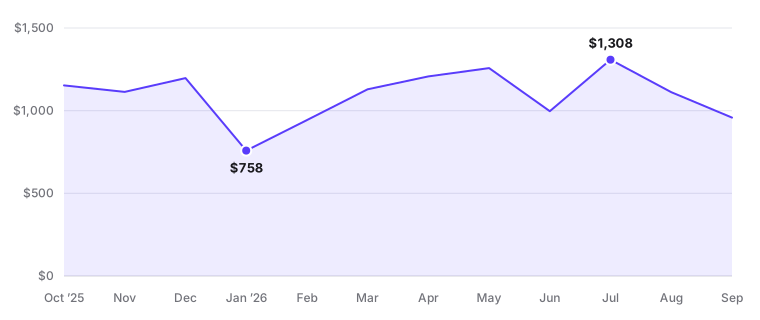
January brought 42% less than July for the same cars. June and September dipped too. That matches Turo’s company filings, which name the second and third quarters as its strongest and the first as flat or lower (SEC filing), and hosts’ reports of a slow September. Budget for the slow month, not the average one. Hover any bar in Raptor’s revenue chart to see that month for one car:

Finally, look at the spread, not the best car. Here are the 9 Tesla Model 3s in the search. They earned anywhere from $237 to $1,269 a month:
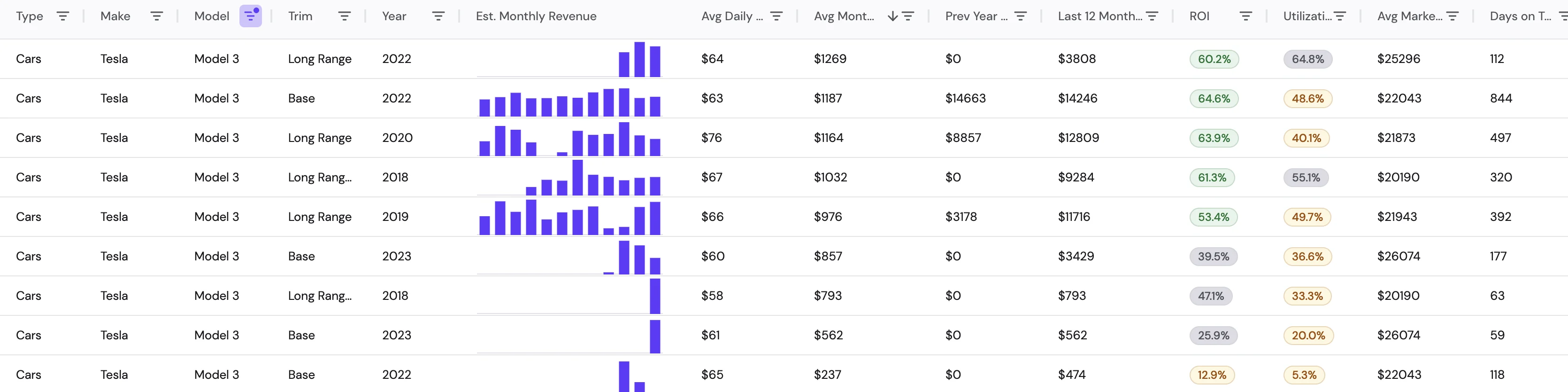
Photos, price, reviews, delivery and the host’s response time all change the result. Hosts say two identical cars in one market can perform very differently. When you estimate your own car, use the median of its comparables and check the bottom quarter too.
6. Compare earnings with what the car costs
Revenue alone doesn’t tell you whether a car is a good buy. A car earning $1,000 a month is a better deal at $15,000 than at $45,000. Raptor’s ROI compares a year of a car’s revenue with its market value, the average asking price of cars for sale with the same year, make, model and trim (formulas). The median Atlanta car had an ROI of 60%.
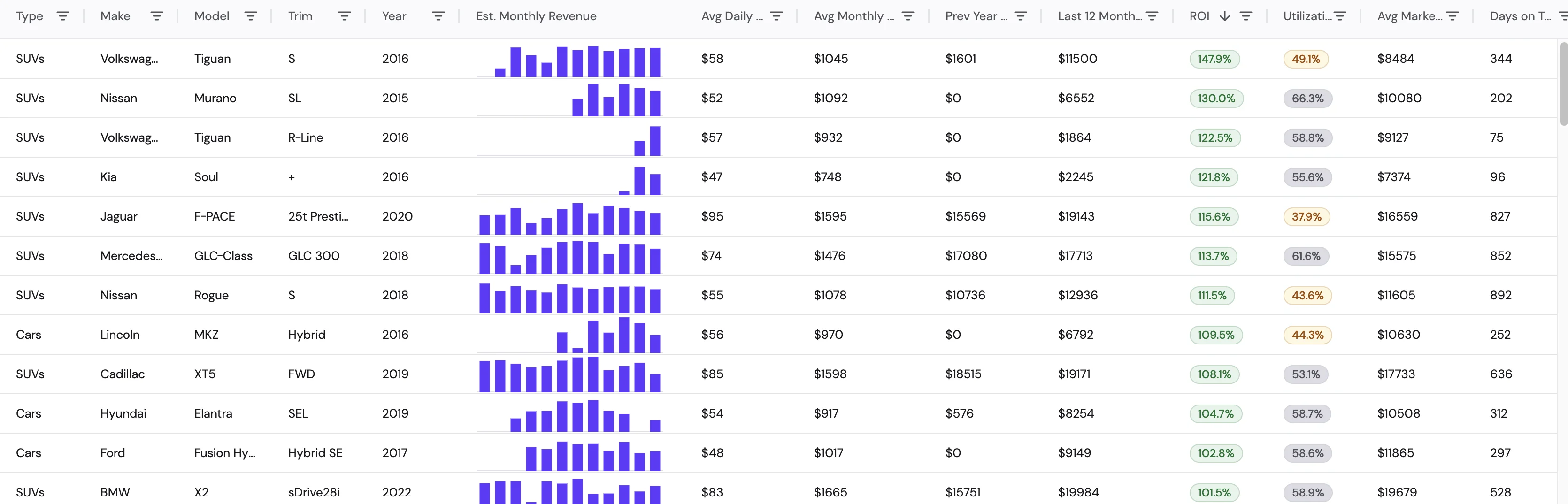
Sort by ROI and older cars take over the top:
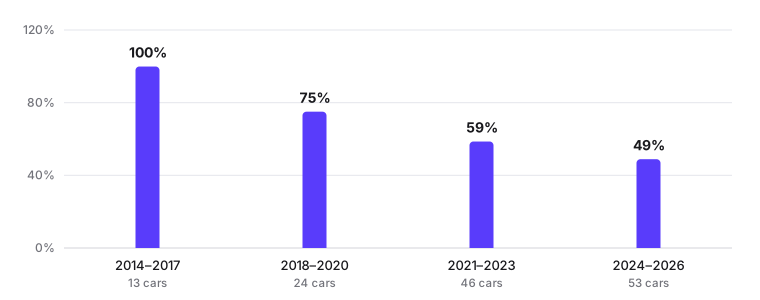
| Model years | Cars | Median monthly revenue | Median market value | Median ROI |
|---|---|---|---|---|
| 2014 to 2017 | 13 | $932 | $10,630 | 100% |
| 2018 to 2020 | 24 | $1,045 | $16,657 | 75% |
| 2021 to 2023 | 46 | $1,107 | $23,423 | 59% |
| 2024 to 2026 | 53 | $971 | $23,394 | 49% |
Older cars earned about the same each month and cost less than half as much to buy. Hosts often say purchase price is your biggest lever. But read the top of that sort with care:
- Turo accepts cars up to 12 years old, under 130,000 miles (Turo help). A 2015 car has only a year or two left on Turo.
- ROI here is before costs. It doesn’t take off Turo’s share, insurance, repairs or tires, all of which weigh more on an older car.
7. Turn it into a yes or no
The question for the car you are eyeing is simple: in this market, will it be booked enough to cover its costs? Work out its break-even days:
Break-even booked days a month = monthly costs ÷ (daily price × your host share)
Your host share is set by your earnings plan. Since January 2026, US hosts keep 70%, 80% or 90% of the trip price, in exchange for paying more of any damage themselves (Turo help). In some cities the share also depends on how far ahead a trip is booked (Turo help). Atlanta hosts were split: 69 cars on the 90% plan, 26 on 80% and 65 on 70%.
Your monthly costs are yours to fill in: the payment or the cash you tied up, insurance, maintenance, tires, cleaning and depreciation. For scale, Turo’s own worked example in its SEC filing came to about $613 a month for the loan and insurance alone on a $27,000 car (SEC filing). AAA puts depreciation on a new car at $4,422 a year (AAA, 2026). Check your insurance before you buy: Turo requires a policy that names the car, and personal policies often exclude car sharing (Turo help).
A worked example. Say you are looking at a compact sedan in Atlanta. The 30 in our table (mostly Corollas, Elantras, Sentras and K4s) had a median price of $58.50 a day. On the 80% plan you keep $46.80 per booked day. If the car costs you $600 a month:
600 ÷ 46.80 = 12.8 booked days a month to break even
Compact sedans in Atlanta were booked 11.2 days a month at the 25th percentile, 14.3 at the median and 17.6 at the 75th. The median car clears break-even by a day and a half. A quarter of them don’t, and a slow January takes the margin away. Compare your break-even with the bottom quarter of comparable cars, not with the best one. If the car only works at the top of the range, it’s the wrong car or the wrong price. The Turo ROI calculator works this out for your own numbers, with depreciation and loan interest included.
8. Find the gaps
The best openings are cars that get booked often and that few hosts offer. In Atlanta, the Hyundai Tucson (5 listings, booked 62% of days), the Nissan Sentra (8, 58%) and the Hyundai Elantra (8, 56%) stand out. The Toyota Corolla (12, 38%) and the Jeep Grand Cherokee (6, 31%) look crowded for the demand they get.
Two more things to look for:
- Types nobody offers. Only 7 of the 200 cars were vans, minivans or trucks, too few to measure from one search. Search those types on their own before you count them in or out. Hosts’ advice is to see what is not there.
- The cars on everyone’s list. Turo’s Top Earning Cars page is built on 2017 to 2021 data (Turo), and hosts suspect some markets are crowded with certain models because everyone reads the same top-10 list. Your own city’s numbers beat a national ranking.
9. Write it down, and repeat it
Export the table to a spreadsheet and keep it (Export CSV). Markets change with every new host, every season and every rental-company price cut. Run the same search every few months and compare the medians: booked days, daily prices and the number of cars like yours. Watch whether prices fall as more cars list.
What this analysis can’t tell you
- Booked or blocked. A day the host blocked looks like a booked day, so booked days and revenue are upper bounds.
- Estimates, not payouts. The figures come from public listing calendars and listed prices, not from Turo’s records of what hosts were paid.
- One area, one search. Our 200 cars are central Atlanta for one set of dates. Another part of the metro, or the airport alone, may look different.
- Your own execution. Photos, pricing, reviews, delivery and how fast you answer guests move your result away from the median, in both directions.
Questions
How do I research the Turo market in my city?
Search Turo for your area with a 3-day window at least three weeks out, collect every car the search returns (Turo shows at most 200 per search, so move the map to cover the rest), then compare them on booked days per month, average daily price, monthly revenue and purchase price. Group by type and model to see what is common, what gets booked and what is missing, and check the slow months before you decide.
What is a good utilization rate on Turo?
Hosts often aim for 20 or more booked days a month, and coaches quote 80%. In our Atlanta sample of 160 cars the median was 44%, about 13 days a month, and only 4 cars reached 75%. Turo's own 2025 average was 15 booked days a month. Use the median for your type of car in your market, and make sure the car still covers its costs at the lower end of that range.
How far ahead should I search?
At least three weeks, with a window of about three days. Turo only shows cars that are available for the whole window, so a search for tomorrow hides the cars that are booked, which are the ones you want to study. Three days also lets cars with a minimum trip length appear.
Is Turo's Carculator accurate for my city?
It is a starting point, not a forecast for one car. It averages large market areas, and its booked-days slider starts every car at 21 days a month, well above what the typical car in our Atlanta sample was booked. Check its estimate against the real listings near you.
How many cars should I look at?
Every car in the area you would host in, not just the first page. One Turo search returns at most 200 cars, so in a large city move or zoom the map and search each part, until new searches stop adding cars you haven't seen.